The current Docker image of the X4 Suite and all future updates can now be conveniently downloaded via Docker Hub. Docker Hub is the standard platform for providing software in the form of Docker images. Any number of Docker containers can be created from the container image of the X4 Suite, which is provided as a template. This allows you, as a system administrator or DevOps manager, to further automate the download, installation, and updating of the software. This means you always have access to the latest version, regardless of whether you run the X4 Suite locally, in the cloud, or in a hybrid scenario.
This also makes it easier to set up different system environments such as test, staging, or production. If you use a Kubernetes-based orchestration platform (e.g., Red Hat OpenShift, Amazon EKS, Microsoft AKS), you can automatically manage any number of X4 containers and scale them as needed. With little effort, you can achieve the best possible performance, become more flexible, and at the same time save costs and reduce update and installation efforts.
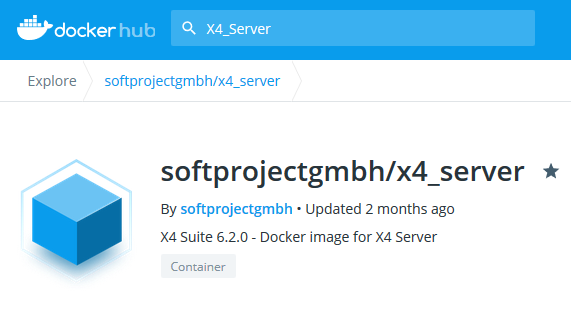
Using the X4 server image via Docker Hub – it's that easy
To integrate the X4 server image, you must install the Docker runtime environment on your target machine. Alternatively, you can use your cloud provider's Docker runtime (e.g., AWS Elastic Container Service). Docker is operating system-independent and available on common platforms such as Linux, Windows, or Mac. It can be managed either via command line interfaces (CLI), via a web interface, or programmatically.

Detailed information on downloading and integrating the X4 Server into your system landscape can be found on the Docker Hub platform:
- Command line commands for retrieving and integrating the X4 Suite image into your DevOps scripts
- Examples of running the images as containers with different system configurations, e.g., setting the ports or using them on databases from different manufacturers
- Download X4 Designer, which allows you to connect to X4 server containers and create and run applications for digitizing business processes.